Customers & sites
Customers, contacts, properties, developments, enquiries, surveys, measurements, rooms, photographs and site access.
The site, the customer and the books. Connected.
For builders, electricians, plumbers, decorators and specialist contractors who need the work and the paperwork to stay together.
UK AWS hosting · Connected records · Your review before action
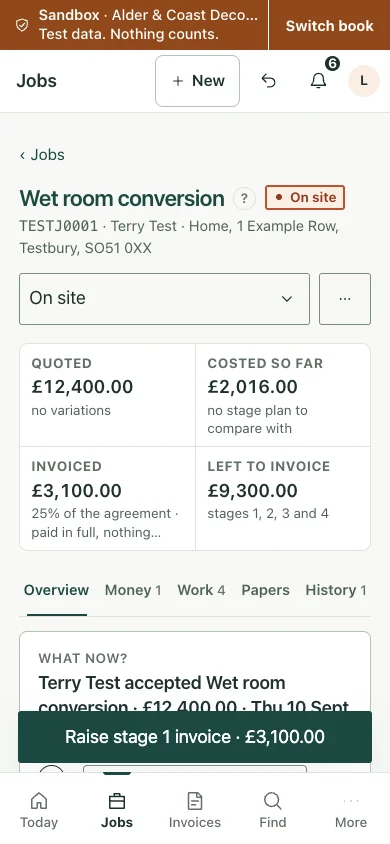
Capture the customer, property, scope and survey.
Build a measured estimate, check the materials and agree the quote.
Order supplies, allocate the crew and confirm the work.
Record time, site progress, changes and completion evidence.
Issue the right stage invoice, chase payment and reconcile it.
Customers, contacts, properties, developments, enquiries, surveys, measurements, rooms, photographs and site access.
Price books, assemblies, measured take-offs, waste allowances, labour, markup, supplier price requests and quote checks.
Supplier catalogues, purchase orders grouped by supplier, delivery evidence, bill matching, price drift and purchasing commitments.
Crew allocation, availability, clashes, travel, work stages, milestones, time entries and mileage.
Daily logs, progress photographs, drawings, snag lists, handovers, equipment servicing and recurring maintenance.
Approved variations, deposits, progress invoices, retention and release dates, CIS deducted and suffered, statements and VAT records.
Scan a room with the iPhone’s LiDAR scanner, capture photos, measurements and the customer’s requirements on site, then turn the agreed scope into a detailed estimate with material take-offs.
Price books, assemblies, supplier orders and labour costs connected to each job, with estimated versus actual margin.
Allocate crews and subcontractors, plan visits and see availability before committing to a start date.
Record changes to scope, get approval and carry the agreed extra work through to the invoice.
Site diaries, progress photos, drawings, snag lists and handover documents in the job’s history.
Track deposits, progress invoices, outstanding balances and retention release dates.
Keep subcontractor records, CIS workflows, bills, VAT records and bank reconciliation alongside the work.
An equipment register with service intervals and next-due dates that remind you by themselves, and repeating visits and reminders for the customers you go back to after the original job finishes.
Keep the context, the records and the next action together. The wider desktop view gives you space to review the detail.
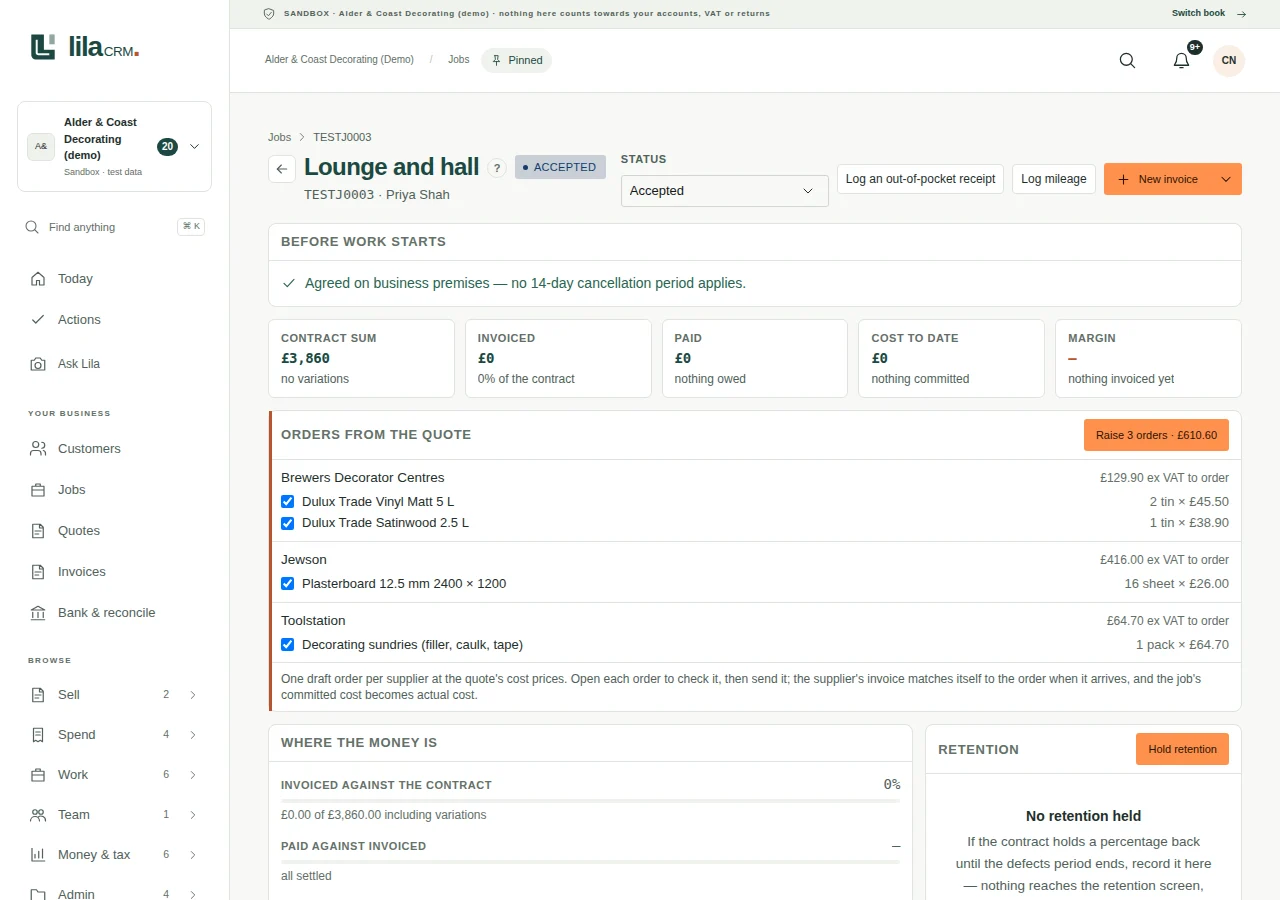
Move from the overview to the source record, with documents and financial history close to hand.
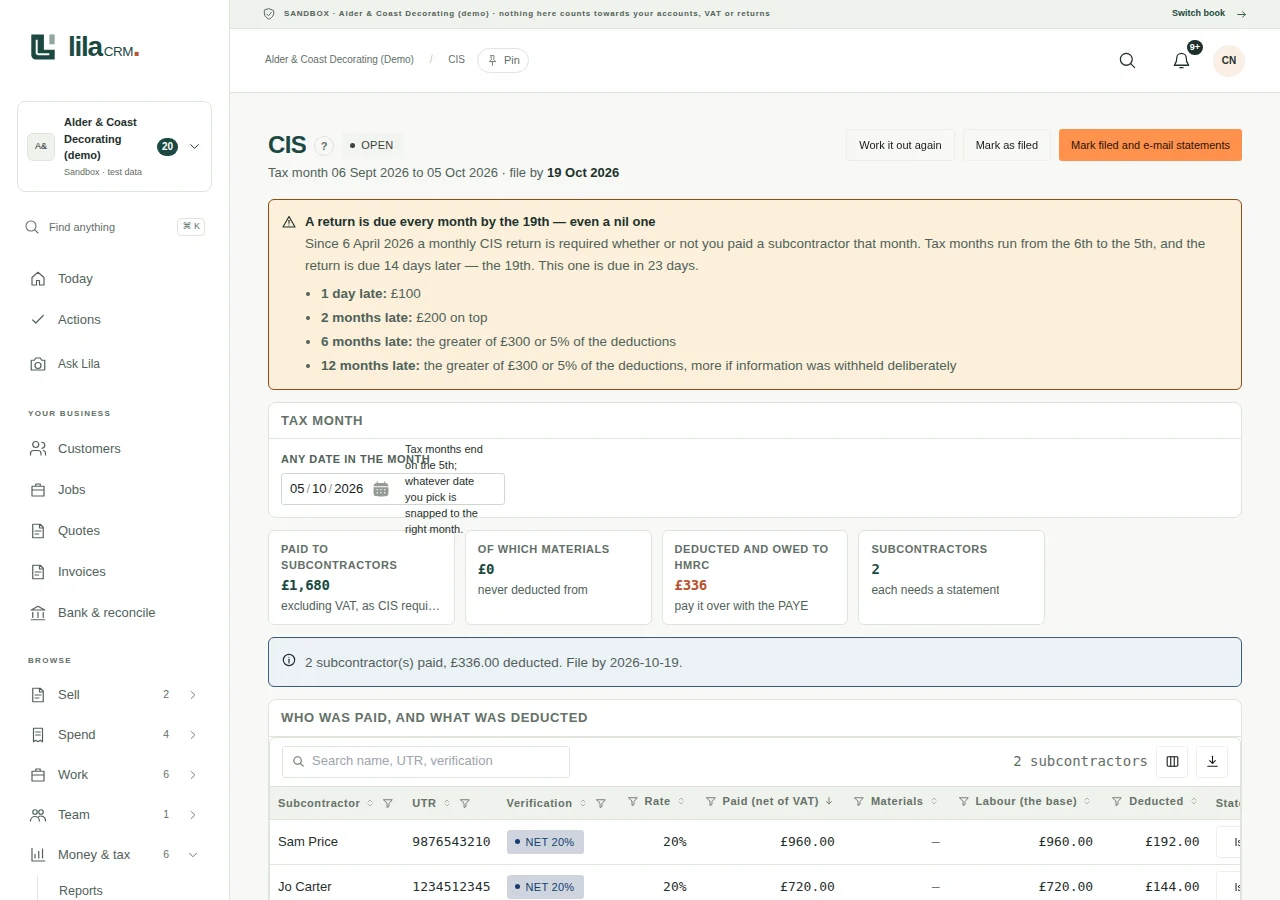
A complete business-finance workspace alongside the specialist tools. Keep the original record, the decision and the financial result connected.
Feeds and imports; multiple accounts; consent status; duplicates; matches; splits; part payments; transfers; rules; undo; evidence links.
Quotes; acceptance; branded invoices; stages and recurring series; payment links; credit notes; aged debtors; statements; reviewed reminders.
Suppliers; bills; purchase orders where enabled; receipts; expense allocation; due dates; recurring costs; credits; mileage; committed costs.
Revenue; profit and loss; balance-sheet working; cash forecasts; aged debtors and creditors; WIP; margins; budget versus actual.
Versioned files; library; tags; search; messages; correspondence; forms; questionnaires; approved sharing; retention and change history.
Enquiries; contact follow-up; proposals; internal projects; marketing and consent controls where the relevant module is enabled.
Capture, read, check, code and reconcile. Keep the original and the decision together.
Photograph receipts, add PDFs or share documents from your phone. Keep the upload status visible and retain the original for review.
Use supported supplier connections to collect invoices. Bring email attachments and correspondence into the document inbox.
Review extracted dates, totals, VAT and supplier details. Flag possible duplicates, unclear documents and uncertain job allocations.
Set supplier, category, value and VAT rules within agreed authority. Routine entries follow those rules; exceptions ask a specific question.
Allocate purchases, mileage and disbursements to the correct job. Keep private, business and client-money treatment distinct.
Match bank entries to bills and invoices, handle part payments and splits, review unmatched items and retain a visible correction history.
Give the adviser the records, context and working papers behind the numbers, with controlled access to the correct book.
Invite your accountant or bookkeeper with the permissions they need. Shared-book membership and authority to act for HMRC remain separate.
Inspect transactions, source documents, reconciliations and unresolved questions. See missing information and estimates before completing the accounts.
Review the ledger, opening balances, trial balance, journals, fixed assets, depreciation and relevant loan or director-account working records.
Export sales and purchases, nominal entries, aged balances, bank reconciliation, VAT/CIS records, hours and supporting documents with a file manifest.
Prepare the applicable year-end, Self Assessment, company accounts and Corporation Tax working information for the entity and accounting period.
Resolve requests, record adjustments and retain the review trail. Hand over documents and exports without confusing a draft with an accepted filing.
Service coverage follows the legal entity, accounting period and enabled workflow. The person with the required authority approves final filings.
Connect the appropriate HMRC VAT service, review obligations and the nine-box return, trace figures to records and retain submission receipts where filing is enabled.
Organise self-employment and property records, quarterly-update figures, annual tax information and calculation reviews. The applicable taxpayer, year and service determine the route.
Use CIS verification and deduction records, payroll/PAYE working information and Gift Aid schedules where relevant. Each connection shows its own readiness and authority requirements.
Keep company identity, filing dates, accounts preparation and company-document history alongside the books. Companies House is a separate service from HMRC.
Review the service, account, taxpayer, consent and authorisation. An accountant invitation does not grant government-agent authority.
Distinguish preparation, ready for review, sent, waiting and accepted. Keep the original acknowledgement; a saved local record is not an HMRC acceptance receipt.
Direct submission is available only for enabled services with verified production access and the required authority. Other workflows provide preparation, exports or external-filing records. CT600, statutory accounts and payroll RTI filing are separate from the preparation tools.
Data is held within the United Kingdom on Amazon Web Services (AWS). Keep control of the AI features you enable and the information they process.
Enable or disable configured AI features to suit your work and data-protection policies. Core record keeping remains usable without AI.
Selected features use locally hosted large language models within the controlled environment. In local-only mode, their inputs and outputs are not sent to external LLM services.
External AI services require provider settings and terms that prohibit using practice inputs and outputs to train their models. Review the provider, processing location, retention and permitted data before enabling a service.
Use separate books, roles, passkeys, revocable access, document history and exports. These controls support UK GDPR compliance alongside lawful use, appropriate agreements and your own procedures.
Keep a copy of the illustrated brochure, or tell us about the records and workflows that matter to you.